Abstract
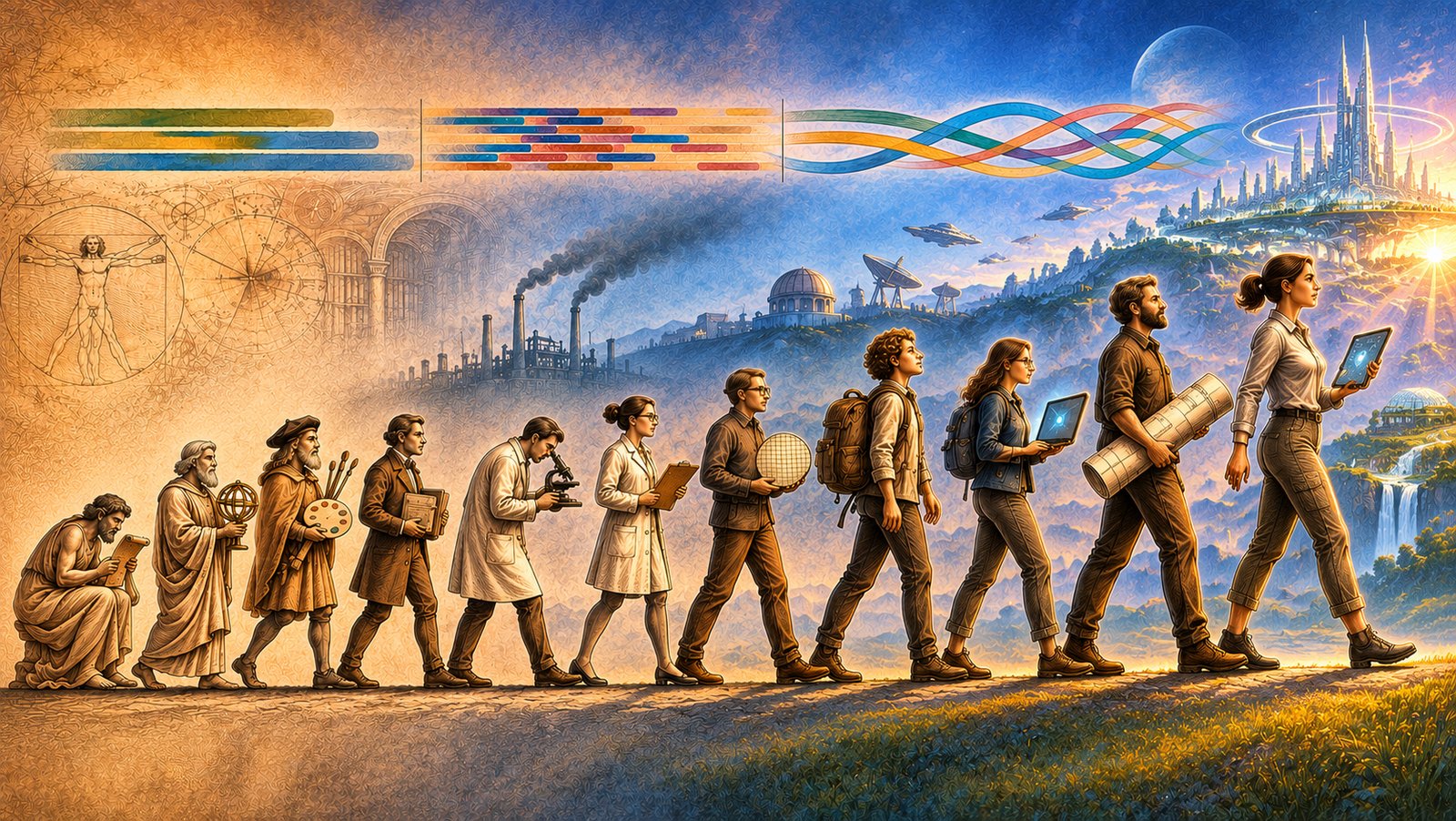
For most of history, the people who changed the world knew a little about almost everything. For the last two centuries, they knew almost everything about a little. AI may be about to reverse that again. This essay follows the curious mind from the ancient polymath through the age of specialization and proposes a name for what comes next: segue and pass. A person follows intuition across fields while AI fills the gaps in knowledge, then hands the work to someone who can carry it further. Every stage holds both moves, and the people and machines who learn that rhythm may shape how ideas are made for the next century.
The Last People Who Knew Everything
Aristotle wrote on logic, ethics, poetry, politics, the motion of the planets and the anatomy of the octopus. Nobody in his time thought this was strange. Knowledge was small enough to fit into one life, and a serious mind was expected to walk across all of it.
The pattern persisted for thousands of years. Ibn Sina wrote the medical textbook that Europe used for centuries and also wrote on logic, music and the soul. Leonardo moved from painting to anatomy to flying machines and back. Leibniz invented calculus while working as a lawyer, a diplomat and a librarian, and he designed a mechanical calculator on the side.
These people were rare, and their range was possible because the map of human knowledge still had edges a single person could reach. Thomas Young, who died in 1829, is often called the last man who knew everything (1). He helped decipher the Rosetta Stone, showed that light behaves as a wave, and wrote on medicine, language and insurance. After him the map grew faster than any one life could follow, and the wandering mind slowly became a luxury.
The Pin Factory
In 1776 Adam Smith described a workshop making pins (2). One worker alone could make perhaps twenty pins a day. Ten workers who divided the job into eighteen separate steps could make tens of thousands. The lesson spread far beyond pins: when each person repeats one narrow task, the whole produces far more than its parts working alone.
The industrial age built its factories on that lesson, and then its universities. Knowledge was divided into departments, departments into fields, fields into subfields. A career came to mean choosing one narrow area early and digging into it for decades. For most of the last two centuries, that was the surest way to make a contribution.
The economist Benjamin Jones gave this shift a name: the burden of knowledge (3). Innovators are born at the starting line, and the frontier keeps moving away from it. Each generation has to study longer to reach the edge, and to get there in time it narrows its expertise. In a large set of data on inventors, Jones found that the age at first invention, specialization and teamwork all rose over time (3). He called the result the death of the Renaissance man.
Specialization worked, giving us vaccines, microchips and the Internet. At the same time, the expert knew more and more about less and less, and the connections between fields were left to luck, to conferences, and to the rare person who still read outside their own discipline.
When Every Gopher Has a Farm
For the last seventy or eighty years, creativity has been one of the main measures of success. Before AI, people looking for something new resembled gold seekers. Some had sophisticated equipment that took years of training and talent to build. Some had simple tools like metal detectors and shovels. Some tried to dig with their bare hands. The difference between them was obvious, and the rewards followed the equipment.
Now anyone with a question and a language model can explore an unfamiliar field in an evening, reaching material that might once have taken a careful amateur months to find and understand. Some people call the results fake, and some of them are. That doesn’t change the trend. The tools have been handed out, and the old line between those who can create and those who cannot is fading.
When everyone owns a metal detector, finding gold stops being rare. What becomes valuable is knowing where to dig, recognizing which find is worth keeping, and getting it into the right hands. And perhaps the metaphor itself is becoming outdated. We are moving from a world of prospectors, competing to find something valuable, toward one where almost anyone can cultivate ideas. Every gopher has a farm.
Creativity does not disappear in this world. Its form and its definition change, and so does the way people have to work together to finish what they start.
Segueing
Ideas used to come mostly from experts working on a specific problem inside their own field. Now people dig deep without the expertise or the experience, and the digging is often random. You put a thought to a language model, and while you read the answer a new thought appears. You send it back, and the cycle repeats. A segue is a smooth transition from one subject to another, and that is exactly what happens in this loop.
A segue does not stay in its lane. A conversation that starts with caring for a pet can move to aquarium filtration, from filtration to closed ecosystems, and from closed ecosystems to the life support systems of a space station. Each step is a short jump. The whole route is one no expert would have planned, and without AI the person who walked it might have struggled to follow the sequence at all.
The theoretical biologist Stuart Kauffman called the set of next steps open to any system the adjacent possible (4). Segueing is a fast way of walking it, guided by curiosity instead of a plan. Through most of history we tried our best to focus on one thing and become an expert. In the future we may learn to let intuition and imagination lead, and let AI help us cross the gaps in knowledge along the way.
This brings back the polymath in a new form. Leibniz carried calculus, law and diplomacy in one head because the body of knowledge was still manageable enough for someone with his abilities to move across it. The new polymath can move across fields without carrying all their accumulated knowledge. Much of that knowledge travels with them in the machine.
Of course, access to knowledge is different from understanding it. An experienced scientist recognizes problems that an enthusiastic amateur may never notice. An engineer knows which elegant solution will fail the moment someone tries to build it. AI can help a wandering mind reach unfamiliar territory, but it cannot guarantee that the wanderer understands what has been found.
The old barriers to exploration are weakening. The need for expertise remains, although its place in the creative process is changing.
The Passing Game
Sooner or later every segue hits a ceiling. The person has followed the thread as far as their judgment can check it, and the next step needs someone who knows the field from the inside. That is where the passing game starts. The idea goes to someone with more expertise, who can test it, correct it and carry it further.
The person who receives the pass segues with it too, from their own expertise, until they reach their own ceiling and pass again. Even the expert at the end is segueing, only from a higher floor. So every stage includes both moves, and the pattern repeats at every scale: one person with a model, a small team, a community, and perhaps one day a swarm of AI agents handing work from role to role.
Imagine someone studying how mushrooms grow through a network of underground filaments. During a conversation with AI, they notice a resemblance between the way nutrients move through that network and the way resources might be distributed across a city. They have no background in urban infrastructure, but the idea seems worth exploring. Eventually they pass it to an engineer, who discovers that some of the proposed mechanisms already exist, others would never work, and one deserves a closer look. The engineer develops that part until it reaches a problem in mathematics, and passes it again. The original observation may turn out to be wrong in several ways, yet something useful can survive the journey.
The structure is far less tidy than this description makes it sound. Threads split, cross and come back. Two people segue toward the same idea from opposite directions. A pass goes to the wrong person and comes back with a new question. The order exists, but as an order of a conversation, and only a record of the whole path shows its shape.
A pass is also a decision about timing. It means recognizing the moment when you have taken something as far as you usefully can. Knowing when to pass may become one of the core skills of creative work with AI, alongside knowing what to ask.
Counting Assists
The old way of treating an idea as property works poorly in this world. Many people who come up with an idea cannot finish it alone, and the person who finishes it often could not have started it. If the first person guards the idea as their own, it dies with their ceiling. If they pass it and lose all credit, they learn to stop passing.
Sport solved part of this problem long ago. In hockey an assist is recorded as a statistic, and a goal can carry two of them. A player can be a star without scoring much, because the passes are counted. Ideas could work the same way. Whoever started the thread, whoever developed it and whoever finished it would all be credited, each for the part they played.
This requires a record of the route. When ideas travel this randomly, the history of how a thought moved from pet care to life support becomes valuable in its own right. It shows who contributed what, where an error entered, and how others might walk the same path. People could never keep such a record by hand at this scale, but AI can help maintain it as a side effect of the work.
It also fits the economy I proposed in The Inequality We Might Want (5). In an age of abundance the economy may become less oriented toward results, and reward may follow reasonable effort. That essay already separates real collaboration, where people with complementary skills build something together, from collusion dressed up as shared ownership (5).
There is an important distinction here. An assist records what happened to an idea after someone contributed to it. The reward for reasonable effort should not depend on whether that idea eventually succeeded. A person may spend months following a promising thread only to discover that it leads nowhere. The effort was made, and the failure may have taught something worth keeping. If someone picks up the thread years later and finds a use for it, the original contribution can still be recognized.
The assist belongs to the history of the idea. The reward belongs to the effort of the person. They may overlap, but they serve different purposes.
Hidden Pitfalls
Intuition in an expert is trained by years of mistakes, so it recognizes when something is off. A wanderer’s intuition is fresh and untrained. AI fills the gaps in a wanderer’s knowledge with the same confident tone whether it is right or wrong. So segueing produces many surprising ideas and also many plausible errors, and the person who walked the path often cannot tell them apart.
This is why expertise is essential in this model. It moves from the beginning of the work to its checkpoints. The pass is the moment when someone with real depth looks at what the wandering found and decides what is worth attention. A world of segue and pass still needs experts, perhaps more than before, and it needs them at the right point in the loop.
The second risk is noise. If millions of people can explore almost anything with AI, they will produce an enormous amount of it. Repeated ideas, mistaken assumptions, abandoned projects, conversations that wander in circles and discoveries that nobody recognizes as discoveries.
In today’s economy, much of this would be considered wasted effort. In an economy of abundance, we may be able to afford it, and there may be good reasons to encourage it. Nobody knows which unexpected connection will turn out to matter. A failed investigation can save someone else years of work. Two people exploring unrelated problems may unknowingly be approaching the same solution.
This is where AI could shine. It can search across the accumulated work, find connections that individual participants missed, identify repeated mistakes and bring promising ideas to people capable of testing them. The noise becomes a field worth exploring in its own right. Of course, finding a pattern is easier than proving that it means something. The discoveries still need to survive contact with reality.
There is another kind of noise. A reward for reasonable effort will attract effort theater: once effort is measured, people produce whatever the measurement can see. AI may help distinguish genuine exploration from manufactured activity, but it can also become another system that people learn to satisfy. Someone still has to define what reasonable means, and that responsibility cannot simply be handed to an algorithm.
Genuine curiosity often reveals itself in the way people approach the limits of their understanding. They encounter something unfamiliar, try to make sense of it, question their assumptions and sometimes change direction. These are signs of engagement, although none can serve as a reliable measurement of effort. Someone may spend months exploring a problem without making visible progress or changing their conclusions. Another person may produce an impressive record of activity without having explored anything at all.
An honest investigation that leads nowhere belongs in the system. An elaborate performance designed only to collect rewards undermines it. AI may help recognize patterns of genuine engagement, but it cannot know someone’s intentions with certainty. We will need ways to discourage manufactured activity while accepting that some genuine effort will be difficult to recognize. Otherwise, we risk turning curiosity into another job with quotas and performance reviews.
A New Way to Work Together
The polymath disappeared because knowledge outgrew the human mind. The specialist took over because one head could carry only a small part of the expanding map. Now much of that knowledge can travel outside the head, and the wandering mind returns with a partner that remembers what it cannot.
That partner changes how we work with each other as much as how we work with machines. In the future we will have to learn to cooperate with AI, and also to work with each other in a new way: to follow a thread without a map, to recognize our own ceiling, to pass at the right moment, and to give credit for the passes we receive.
None of this is taught systematically in school today. We still encourage students to choose a field, master its foundations and demonstrate what they can do independently. Those skills will remain useful, but the ability to move between fields, judge the limits of one’s understanding and bring other minds into the work may become just as important.
The rhythm is old. Every good conversation has always worked this way, with one person taking a thought as far as they can and another carrying it further. What is new is the reach. A thread that once ended at the edge of one person’s knowledge can now cross half of human learning in an afternoon, and pass through many hands before it becomes something worth keeping.
Sources
- Andrew Robinson. The Last Man Who Knew Everything: Thomas Young. Pi Press, 2006.
- Adam Smith. An Inquiry into the Nature and Causes of the Wealth of Nations, Book I, Chapter 1. 1776.
- Benjamin F. Jones. “The Burden of Knowledge and the ‘Death of the Renaissance Man’: Is Innovation Getting Harder?” Review of Economic Studies 76, no. 1 (2009): 283–317.
- Stuart Kauffman. Investigations. Oxford University Press, 2000.
- Andrei Navrotskii. “The Inequality We Might Want: Merit-Based Redistribution for the AI Transition.” claudedna.com, November 14, 2025.